
Begin with one open ear and move the smallest curl group overlapping the jewelry. If you want both earrings visible, use separate local anchors or a small half-up. Check the earring closure and nearby hair together before relying on the pairing for a long event.
Choose the opening the earrings need
Put the earrings on with the hair in its normal shape and look from the front and a slight angle. A compact stud may disappear within the curls but appear clearly in profile. A longer drop may need room below the lobe. Decide whether you want constant visibility or an occasional glimpse before clearing a large section of hair.
Move the nearest curl group gently with your hand and leave the rest of the outline alone. You may find that opening one side gives the jewelry enough emphasis. The options below preserve different amounts of texture near the face, so choose according to the earring and the section's comfortable reach.
Choose one open ear as a starting point
Try clearing one side while leaving the other in its usual shape. This gives the jewelry a focal role without requiring a symmetrical hairstyle. Use the side that feels comfortable with your part and growth pattern, then compare the opposite side if the haircut allows. The choice can also relate to the neckline or a hair accessory you plan to wear.
Do not assume the open side has to be flat. A soft curve above the ear can leave the earring visible while preserving texture. Hold the section in a few positions before fastening: slightly backwards, gently upwards or just away from the lobe. The smallest change that gives the jewelry space often looks more integrated than clearing a broad strip from the temple to the nape.
Move curl groups rather than individual strands
When curls are already arranged in groups, handle those groups as units where possible. Lift the section near the ear, guide it into the chosen direction and let the surrounding hair settle. Separating many individual strands just to make the area perfectly smooth can change more of the style than you intended.
For waves, a simple tuck may leave a natural bend framing the earring. For coils, a small local pin or a gentle sectioned arrangement may create the opening you want. Aveda and MoKnowsHair's tapered-cut tutorial treats a temple-to-ear area separately from the remaining hair. The broader useful idea is local styling: you can change a small section while preserving the texture and fullness elsewhere.
Pick a fastening that suits the section
Choose a clip or pin that can hold the gathered amount comfortably. A tiny fastening may struggle with a large curl group, while a heavy barrette can pull on a small one. Place it where the section has enough length and support rather than stretching it towards a predetermined spot. If the hair springs back immediately, adjust the location instead of increasing tension.
Open the fastening fully when placing and removing it, and check that it does not press against the earring back or glasses arm. The area around the ear is already busy with accessories, so a slightly higher anchor may be more comfortable. If you cannot find a position that feels good, try a different piece of jewelry or a less open hairstyle rather than forcing the combination.
Inspect the jewelry's shape and closure
Look at the actual earring, including the back and any open links, hooks or decorative edges. Consider how it meets the nearest hair when you turn. Some pieces may catch your own texture more often than others, so try them at home before relying on them for a long event. The category name alone does not tell you how a particular earring will behave.
If hair catches, support the section and free it gently rather than pulling the jewelry away through the strands. You might choose a smoother piece, move the nearby hair farther back or reserve that pair for a gathered style. This is a practical fit check between two things you want to wear. It does not mean that textured hair requires small or plain earrings.
Choose between a glimpse, an open ear and a full statement
An earring does not have to remain completely visible to contribute to the outfit. A small reflective detail can appear through curls as you move. If that is the effect you enjoy, a slight shift of the nearest group may be enough. Do not remove half the side volume simply because the jewelry is hidden in a straight-on photograph.
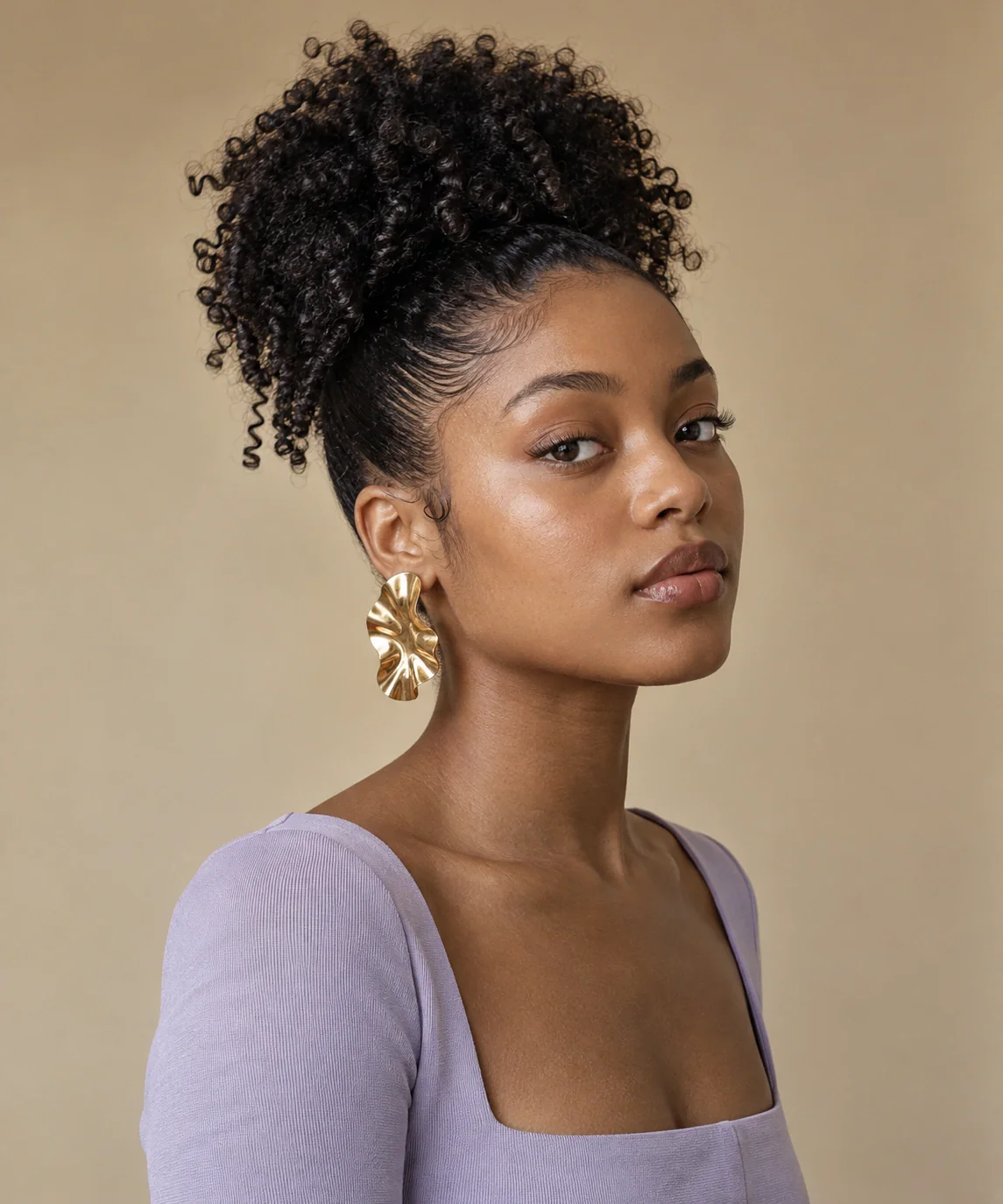
For a recognizable statement shape, open enough space around its main outline to see what you chose. A circular earring might need room below the ear; a sculptural stud may need the lobe exposed. Compare the hair held slightly backwards with the same section lifted gently upwards. Keep whichever direction leaves the earring clearer without changing more of the hairstyle than you want.
For both earrings as a main feature, use two nearby anchors or a modest half-up and check the result with the neckline. A high collar can add another shape close to the jewelry, so adjust the earring, the hair or the collar relationship as a group. Finish by turning and removing one earring carefully to see whether the closure catches. Visibility is only part of the pairing; a piece that repeatedly snags may belong with a different hairstyle even if it photographs beautifully.
Keep both ears visible with a partial arrangement
If you want both earrings in view, gather the front sections into a small half-up or create separate local anchors above the ears. Leave the crown and lower texture as full as you like. Compare how much hair you collect on each side; matching the visual openness may not require identical section sizes.
With shorter hair, a soft headband may provide the opening without forcing the sides to reach a central tie. With longer hair, a low gathered style can show the earrings while the tail preserves the texture. Choose the structure that suits the haircut. You do not need to create a perfectly slick surface around the face simply because both pieces of jewelry are part of the look.
Finish with a comfort and removal check
Turn your head, put on your outer layer and sit down with the complete arrangement. Notice whether the earring touches a collar, catches a curl or presses against a clip. Change the crowded area rather than tightening the whole hairstyle. If you will wear a scarf, check it as well; the extra fabric may alter which earring length feels practical.
At the end of the evening, remove the jewelry with the nearby hair supported, then release the fastening. Store the successful combination as a simple note or photograph: one pinned curl group with hoops, or a soft band with drop earrings. The goal is a small set of comfortable pairings that let you enjoy both texture and jewelry without rebuilding your hairstyle every time.
Decide how much of the earring needs its own space
Put on the earrings and identify the part you most enjoy: the color near the lobe, the hanging shape or the movement below the hairline. That feature determines where visibility matters. You may not need to expose the entire ear or move a large section of texture. Try creating a small window around the chosen detail while leaving the surrounding shape intact. This lets the jewelry become readable without assuming that all of the hair near it must be compressed or removed from the composition.
Watch the result as you turn and speak. A moving earring may appear between texture groups in a way you like, while a more graphic shape might benefit from a consistently open area. Compare those two intentions before choosing the final placement. If the jewelry catches, prioritize a comfortable arrangement or a different pair rather than preserving the appearance at all costs. The useful brief describes both what should be seen and how the hair and earring should coexist during the ordinary movement of the event.
Record the texture groups you actually moved
Once you find a comfortable arrangement, photograph the side and note which groups were redirected. Use visible landmarks such as the section above the temple or the curl beside the ear, rather than trying to assign precise measurements. This makes the style easier to repeat while allowing for the way your texture settles on another day. You are remembering the function of the placement, not forcing every group to occupy the identical position shown in the first photograph.
On the next wear, start with the same goal and use the groups available in that day's shape. Check the clasp and the hanging area again after making the adjustment. If a different section gives the desired opening more comfortably, use it and update the reference. This approach keeps the styling responsive to your hair while preserving the jewelry relationship you liked. It also reduces unnecessary handling, because you can focus on the small area that affects visibility instead of rebuilding the entire hairstyle around a pair of earrings.
Your questions, considered.
Do I have to smooth my curls to show earrings?
No. A local tuck, pin or half-up can create space around one or both ears while leaving the rest of the texture visible. Start with the smallest section that overlaps the jewelry and adjust only that area.
Is it okay if only one earring is visible?
Yes. One exposed ear can be a deliberate asymmetric detail. Check the full outfit and decide whether you like the balance between the open side and the fuller hair on the other side. Both earrings do not need equal visibility.
What should I do if an earring catches in my hair?
Support the hair and free it gently rather than pulling the earring through. Then change the nearby placement or choose a different pair for that hairstyle. Inspect the actual closure and decorative edges, because two earrings in the same general style can behave differently.
Sources & what they support
The notes below explain the scope of each source. Hairstyle selections, outfit combinations and comparison exercises are HairSparks’s editorial suggestions; the links do not imply endorsement.
- Aveda and MoKnowsHair: Styling a tapered cut ↗Example of styling a localized temple-to-ear section on short coily hair. The guide borrows the idea of selective placement without assuming braiding expertise.
HairSparks and Hair Muse share the same publisher. App mentions are promotional. Read our editorial policy.