
For a short fringe, change spacing and the corners first. For longer bangs, compare a small center opening with a side sweep. If the ends cannot reach the clip comfortably, move the anchor closer or keep that section on the forehead.
How to style bangs: change the direction first
Let the fringe settle before moving it. Identify the shortest center, the longer corners and any strong natural direction. Those areas determine which styling changes are available. A short center can stay visible while the corners move outwards; a longer fringe may reach a side clip. Trying to send every piece to the same place can hide those simpler options.
Use the current length as the starting point for the mood you want. The first trial can be done with your fingers before adding products. Check the result with your head upright and your eyes clear, since a sweep that works only in a tilted selfie is unlikely to be a comfortable everyday version.
Create a quiet, neat version
For a calmer mood, arrange the fringe into a clear overall line while keeping the rest of the hairstyle simple. Use the part or natural opening as your starting point. Guide the corners so they connect with the side sections rather than turning independently. A neat fringe does not need to be a solid, motionless sheet; some separation can remain.
If drying is part of your routine, set the direction while the fringe is still workable and check the shape as it dries. ghd's fringe guidance discusses directing the fringe during drying and using product sparingly. Follow the instructions for your own tools and products rather than assuming more heat or more hold will make the line better. Once the shape is comfortable, leave it to settle before making another adjustment.
Open the centre for a softer frame
On a fringe with enough length, use your fingers to create a small opening near the centre. Move the pieces gradually towards the sides and see where the ends sit. The opening can be subtle; it does not need to become a dramatic curtain shape. Check whether the corners blend into the longer hair around the temples.
If a short central section sticks out or immediately returns forward, reduce the opening rather than forcing it wider. You can keep the centre mostly in place and soften only the corners. Pair this version with a loose low tie or natural waves if you want the rest of the hairstyle to share the softer feeling. The exact result depends on your existing cut, so treat the first attempt as a comparison.
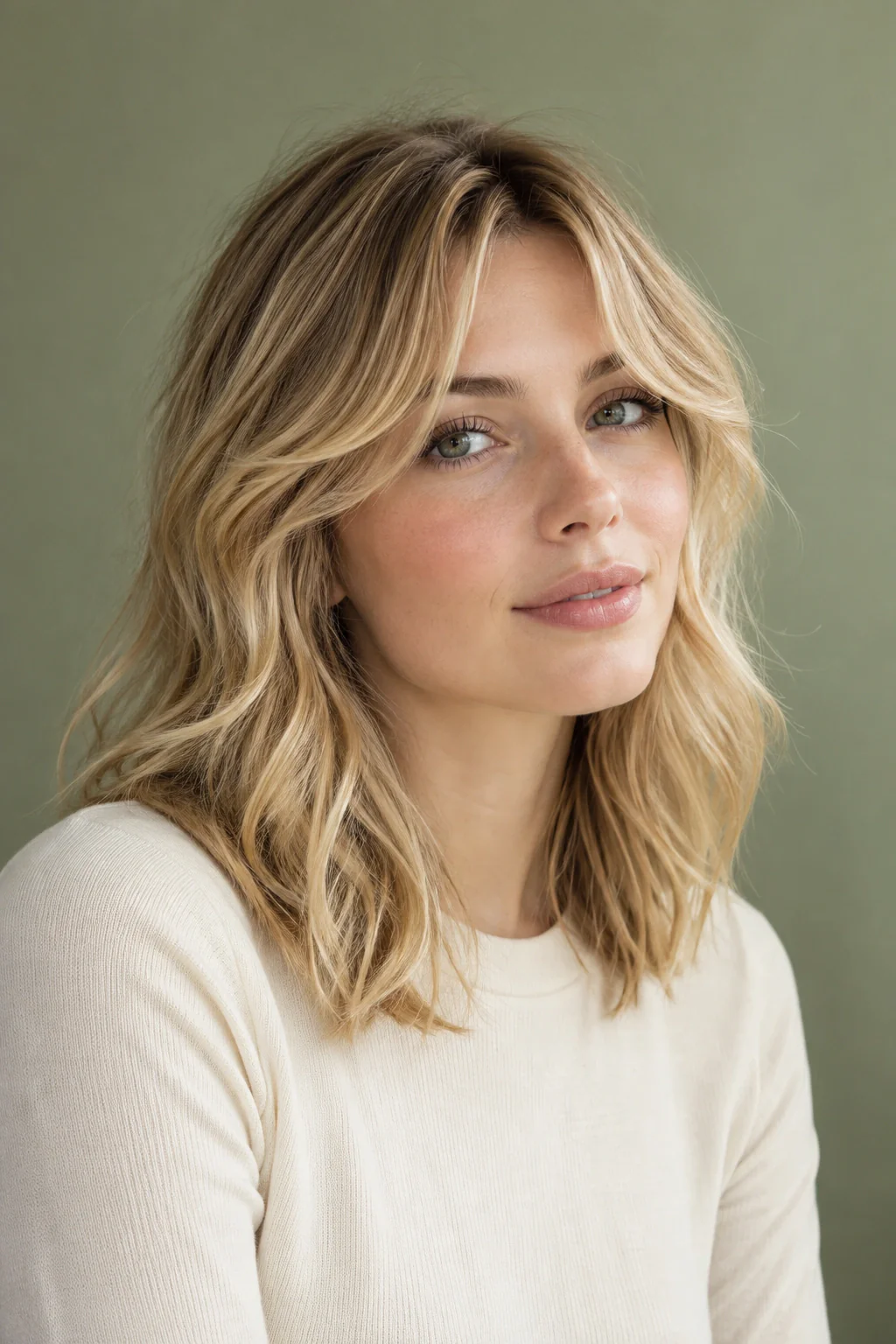
Try a side sweep without pretending the length changed
Guide the fringe diagonally with your fingers and identify the point it can reach comfortably. A small shift may create enough asymmetry to change the mood. Longer corners can connect to an ear tuck or clip; shorter pieces may remain across the forehead. Let that difference be visible rather than trying to make every strand follow one long, uninterrupted line.
Use a discreet clip if you want the swept section to stay away from the eye. Place it where there is enough hair to support the fastening, not at the very last millimetre of the ends. If the sweep only works while you tilt your head, choose a smaller change. The style should belong to your ordinary posture and movement, not require you to hold a pose all day.
Make separation part of a playful finish
A few distinct groups can give a fringe a lighter, more playful appearance. Use clean fingertips to arrange the existing pieces rather than repeatedly combing them into a uniform curtain. Start with less separation than you think you want and step back from the mirror. Strong close-up gaps may look different when you see the full hairstyle.
If you use a finishing product, follow its directions and begin with a small amount suited to the section. Too much can make the fringe look coated or separate more than you intended. Work on the ends or selected pieces if that is appropriate to the product, then reassess. The playful version can remain subtle: a slightly irregular line or one shifted corner may provide enough change.
Use a clip to create an intentional alternative
On days when the fringe feels inconvenient, make the fastening a visible part of the look. A slim side barrette can create a clean diagonal; two small clips can hold sections away from the centre. Choose the placement for comfort and reach first, then consider symmetry or color. A clip is a styling option, not evidence that the fringe has failed.
Try the accessory with the rest of the hair in its usual arrangement. If the forehead feels too exposed, leave a small section loose or place the clip closer to the face. If it feels crowded near your glasses, move the anchor above that area or use a different shape. The best clip arrangement is one you can reproduce easily when the fringe is between lengths or you want a different mood.
Pair the fringe setting with a complete hairstyle
Choose the front first, then give the rest of the hair a supporting job. A neat short fringe can sit above a loose bob, while a softly opened fringe can connect to a low ponytail. A side-swept fringe can echo hair falling over the same shoulder. These pairings create different moods without requiring the fringe itself to perform every part of the transformation.
With a clipped fringe, check how much of the temple remains visible. If the forehead feels more open than you wanted, leave the longer corner loose or place the clip closer to the face. With a center opening, gather the rest of the hair low and compare that clean outline with loose lengths. You may prefer the same front setting in both versions, using the back to change the occasion mood.
Add the glasses and earrings before the final adjustment. A fringe corner resting across a frame may need a slight redirect, and a side clip may compete for the same space as an earring. Move the local section or accessory instead of changing the whole fringe. Save the combination as a short action sequence: narrow opening, low tie, corners loose. That is easier to recreate than an adjective such as romantic or polished on its own.
Separate styling limits from a trimming decision
If the fringe cannot make the shape you want, note why. It may be too short to reach the side, too long for the line you prefer or cut with corners that do not connect the way you imagined. Those are useful details for a stylist. They are more specific than deciding that the fringe is wrong after one unsuccessful styling attempt.
Bring two pictures to your next appointment: the usual fringe and the alternative you tried. Explain which features you want to keep and how much daily work feels realistic. ghd recommends professional cutting for a fringe and matching it to your maintenance preferences. In the meantime, use the styling versions that fit the current length. There is no need to improvise a new cut merely because one mood is harder to create today.
Map the fringe into movable and fixed areas
Look at the fringe in its ordinary state and identify which sections can comfortably move toward the sides, which prefer to fall forward and which connect with the longer hair. Sketch these as simple zones in a note. Then choose one mood change that works with the movable area, such as opening the center slightly or directing an outer section toward a clip. This avoids making the whole fringe responsible for an effect that only some of its length can currently support.
Compare the variation with the rest of the hairstyle rather than studying the fringe alone. A small change at the front may look more coherent when the side lengths follow the same direction, or it may work as a contrast against a familiar back shape. Photograph the complete outline with the outfit. If a section keeps returning to its original position, treat that as information about the present styling options. You can choose another arrangement without assuming that the fringe itself needs to be cut immediately.
Keep a mood menu with realistic names
Create three entries that describe actions you can repeat: forward and lightly separated, center opened, or one outer section clipped. Add the mood each gives you, using your own words. This is more useful than naming the versions after photographs whose fringes have different lengths and density. For each entry, note the accessory or preparation step required and the point at which you stop refining. A small menu makes the fringe feel versatile without requiring a new experiment every time you get dressed.
Wear each version during an ordinary activity and record whether it remains comfortable. If you repeatedly touch one arrangement, identify whether the issue is a section near the eyes, a fastening position or simply an unfamiliar appearance. Adjust the practical issue and try again if you still like the idea. Keep the entries that you want to repeat and remove the ones that require more attention than they are worth to you. The menu should reflect your actual fringe and routine, with room to change as the length and your preferences evolve.
Your questions, considered.
Can a short blunt fringe become curtain bangs through styling?
It may allow a small opening, but it cannot gain the length or graduated corners of a different cut. Try a modest separation and see where the ends sit. If you want a fuller curtain shape, discuss the required length and cut with a stylist.
Why does my fringe separate more after I add product?
The amount or formula may be too much for that small section, or it may be designed to create definition. Review the directions and use less next time. Start with the fringe's direction and drying routine before assuming that extra hold is the answer.
What can I do while my fringe grows?
Use the available length for a gentle side sweep, a small centre opening or a comfortable clip. The best option may change as the corners and centre grow at different visible lengths. Keep a few simple versions so the in-between stage does not depend on one exact shape.
Sources & what they support
The notes below explain the scope of each source. Hairstyle selections, outfit combinations and comparison exercises are HairSparks’s editorial suggestions; the links do not imply endorsement.
- ghd: How to choose the right fringe ↗Professional background on fringe styling and maintenance. Used for routine questions and the recommendation to discuss the cut with a stylist.
HairSparks and Hair Muse share the same publisher. App mentions are promotional. Read our editorial policy.