
Choose whether minimal means fewer visible details or fewer daily steps. If time is the priority, build around your normal finish and a repeatable gathering. If a precise edge matters more, ask what styling and appointment routine that edge requires before committing.
Choose which kind of simplicity you want
There are two different briefs here: a simple-looking hairstyle and a simple morning routine. A sleek bob with a precise edge may look restrained while asking more of your styling time. A natural curl shape may have a more varied surface while fitting your routine comfortably. Decide which kind of simplicity matters most to you.
Start from the options below and identify the feature you would keep even on an ordinary day. That could be a part, a visible neckline, a repeated low gathering, or the curve of a crop. A signature becomes personal through repetition; it does not need several accessories or a dramatic color contrast to be recognizable.
Find your natural repeat
Look through a few recent, ordinary photographs of yourself. Which arrangement appears most often when you were not dressing for a special occasion? Perhaps you usually tuck one side, gather the hair low, or let a particular part form. That repeat is useful evidence about your comfort and habits. Instead of abandoning it, consider whether a clearer shape or better-fitting accessory would make it feel more intentional.
Try writing “I keep doing this because…” and finish the sentence honestly. It might be comfortable with glasses, easy after washing, or simply familiar. Then write what you would improve. This separates a useful habit from a detail you tolerate because you have not found an alternative. Minimalism works best when it edits around genuine preferences, rather than asking you to start performing an entirely different morning routine.
Choose one memorable feature
A restrained hairstyle can still have a recognizable signature. Possibilities include a distinct fringe, an off-center part, a softly rounded perimeter, a tucked side, or an unusually plain accessory in a favorite color. Choose a feature you like seeing repeatedly. If you need a different dramatic detail every day to stay interested, a minimalist approach may be only one mode you enjoy rather than your permanent direction.
Keep the rest of the brief supportive. A signature fringe may need a quieter outline around it; a sculptural shape might need no accessory at all. Photograph the whole look with your usual clothes and ask whether the intended feature is visible. If it disappears, you may need a slightly clearer version. If it overwhelms everything else, reduce its scale. The objective is recognition, not maximum visual impact.
Think about negative space
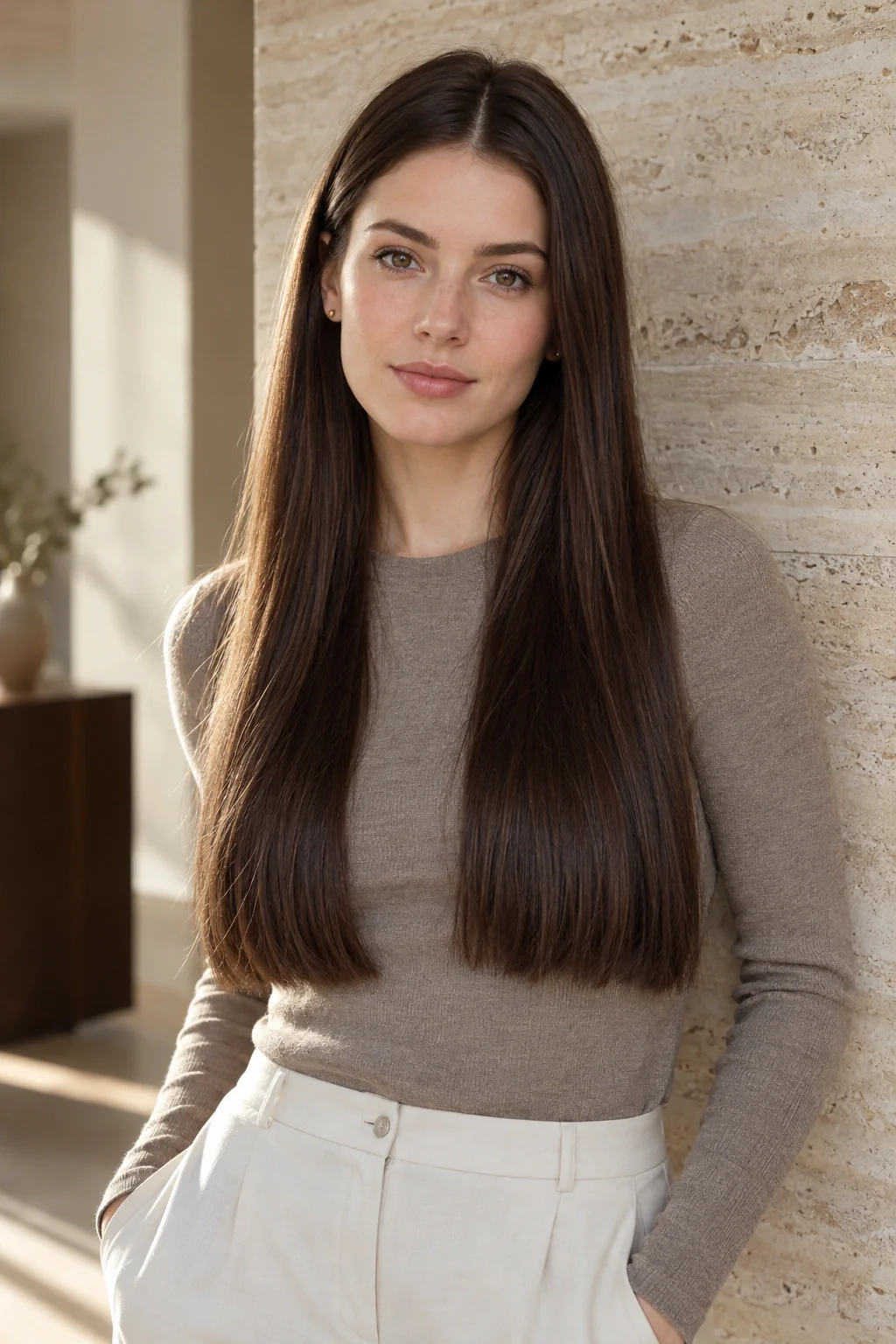
The areas your hair leaves visible help define the style: a neckline, an ear, a gap around glasses, or the line between hair and collar. Consider these spaces when comparing lengths. A reference that feels calm may appeal because it reveals a clean neckline, not because the haircut itself is particularly short. You may be able to explore that feeling with a different arrangement of your existing hair.
Test the idea with the clothes you wear most. A collar can change where the ends sit and whether the silhouette feels crowded to you. Earrings may become more noticeable when one side is tucked. A high neckline may make you prefer the hair gathered away. None of these combinations is forbidden. They are simply useful ways to discover which spaces you enjoy leaving open and which parts of the hair you want to remain visible.
Edit the color brief carefully
A minimalist color direction can mean a close relationship between roots and lengths, restrained contrast, or one clear overall shade. It does not have to mean your natural color, nor does a single-looking shade guarantee simple upkeep. If you are considering color, explain the impression you want and ask a colorist about the actual maintenance from your starting point. A quiet-looking result can still involve a substantial service.
Compare references at a similar overall depth before deciding how warm or cool you want the result to feel. If one image is much lighter than the other, you may be responding to brightness rather than tone. Keep your color notes separate from your cut notes until you can describe each in a sentence. This helps you decide whether you need both changes or whether one refined detail would already give the look the clarity you want.
Build a three-version menu with no extra purchase list
Write down the normal version, the rushed version, and the occasion version. Use the same cut and familiar texture for all three. With long hair, that could be loose with an off-center part, a low ponytail, and the same ponytail with an exposed earring. The change is placement, so the menu does not require three separate product routines.
For a bob, the normal version might be your usual dry finish, the rushed version a side tuck, and the occasion version a small barrette at that side. For a curly crop, keep the shape consistent and vary the front direction or a narrow temple section. Choose changes your length already supports. A fallback that needs pieces to reach farther than they comfortably can is not a dependable shortcut.
List the tools or accessories that appear in more than one version. Put those within easy reach and try the full menu for ordinary activities. If the fastest option is the one you keep choosing, let it influence the next haircut brief. You may want more support for that shape, not a more elaborate everyday target. The result should be a few decisions you can repeat, with room for your texture to vary from one day to another.
Ask for a cut that supports the brief
Bring the stylist a short description of your main priority, a reference for the outline, and a photo of your ordinary finish. Ask where the proposed cut needs precision and where it can tolerate variation. Discuss how it would look after your usual drying routine and which areas would need attention as it grows. This produces a more useful conversation than requesting “something low maintenance” without describing what maintenance means to you.
Finish by identifying the detail you want to keep even when the hair is not freshly styled. It might be the visible neckline, the way the front falls, or enough length to gather. That is your anchor for future appointments. You can refine the rest over time without rebuilding the entire aesthetic. A minimalist hairstyle gains personality through a few choices that remain yours, including on the days when you are paying attention to other things.
Find the signature detail you would miss if it disappeared
Look at several photographs of yourself in outfits you like. Ignore whether the hair looks especially styled and identify any repeated feature: a visible ear, a slightly off-center part, an airy edge or a compact outline. Ask which detail would make the hairstyle feel less like yours if it were removed. That is a useful candidate for a minimalist signature because it already has a place in your preferences. You do not need to invent a dramatic feature simply to prevent a simple hairstyle from feeling anonymous.
Try preserving that detail while simplifying everything around it. If the open ear is the signature, reduce extra clips and let the placement carry the look. If the outline matters most, choose jewelry that does not obscure it during the comparison. Take a photograph from a distance where the outfit remains visible. The exercise is about identifying what gives a simple arrangement character, so judge the whole composition rather than searching for intricate detail that minimal styling was never meant to provide.
Compare visual simplicity with practical simplicity
Make two columns for a hairstyle you are considering. In the first, describe what appears simple in the image: one length, a smooth surface, a single part or no visible accessories. In the second, write the actions you believe are needed to create and maintain that appearance, leaving question marks where you do not know. A sparse-looking image can contain an extensive routine, while a visibly textured style can be simple for the person wearing it. The columns prevent those ideas from being treated as interchangeable.
Take the unanswered questions to a stylist or use an ordinary styling trial where possible. Then decide which kind of simplicity matters more to you. You may willingly spend time on a very clean outline, or prefer a flexible finish that takes fewer decisions. Either choice can fit a minimal aesthetic. Your final brief should state both the visual intention and the routine you accept, so the result feels uncomplicated in the way that actually matters to your day.
Your questions, considered.
Does minimalist hair have to be straight?
No. A clear silhouette and restrained detail can work with waves, curls, coils, or straight hair. The routine should accommodate your texture instead of treating a smooth surface as the definition of simplicity.
Is one-length hair always easier to manage?
Not necessarily. Practical upkeep depends on your hair, length, preferred finish, and routine. Ask how the specific proposal would behave for you rather than relying on a haircut label as a maintenance promise.
How can I avoid a look that feels generic?
Keep one detail that you personally enjoy: a shape, part, fringe, accessory, or placement. Look at your existing habits for clues, then make that detail deliberate enough to recognize without adding unnecessary elements.
Sources & what they support
The notes below explain the scope of each source. Hairstyle selections, outfit combinations and comparison exercises are HairSparks’s editorial suggestions; the links do not imply endorsement.
- L’Oréal Professionnel: preparing for a hair consultation ↗Consultation context: bringing pictures, explaining styling habits and discussing maintenance with a professional. It supports the consultation advice, not our aesthetic judgments about individual looks.
HairSparks and Hair Muse share the same publisher. App mentions are promotional. Read our editorial policy.