
Keep the band, ear cups and chair clear of bulky fasteners. Use a low ponytail or loose braid for longer hair, a small half-up section for layers, or a separate front direction for short hair. Test putting the headphones on and taking them off.
Choose the hairstyle around three contact points
Put on your headphones in their normal position and sit in the chair you use most. Notice the band at the crown, the cups beside the ears and any headrest behind you. The hairstyle has to share those three spaces. Start with a style that keeps its fastening away from them, then check the movement of removing the headphones.
A low ponytail can leave the crown clear but may meet a chair; a high clip can avoid the chair and still block the band’s path. For medium hair, a small half-up section may be easier than forcing short layers into a ponytail. Curls and coils can stay full wherever the equipment fits comfortably. Put your glasses on too, so a hairpin does not end up crowded beside the temple arm and ear cup.
Make space for the cups without flattening every side
Try placing the ear cups with the surrounding hair in its usual direction first. Then compare a version with the sections immediately above the ears gently arranged away. You are testing how much hair actually needs moving, not working toward the smoothest possible head. Someone with a full curly outline might open a small area around each cup while keeping the rest of the shape generous. Straight hair might simply sit more comfortably behind the shoulders while the equipment is on.
If you need to secure a side section, put its fastener outside the contact area you identified. Check that the clip does not become trapped when you swivel or lift the cup. A tiny decorative pin is still a hard object, even if it disappears visually. Likewise, a very neat ear tuck may stop working as soon as you lean down for a notebook. Assess how easily you can restore it before deciding whether it is a practical arrangement for repeated use.
Leave room for asymmetry if your setup creates it. A microphone on one side, or the ear you uncover to speak with someone, can make one side more active than the other. You can arrange that side more securely and keep the opposite side softer. There is no requirement that the hairstyle be identical left and right. A purposeful difference often feels less laborious than repeatedly repairing a balanced shape that the equipment keeps disturbing.
Choose a gathering point that works with your chair
A low ponytail is an easy starting point, but low is not one precise location. Gather the hair loosely at the nape, slightly above it, then a little to one side. Sit normally each time. See whether the tail lies over the chair or becomes trapped between your back and its surface. If you use a headrest, check the complete arrangement against it. You should be able to use the chair naturally without leaning forward to preserve the hair.
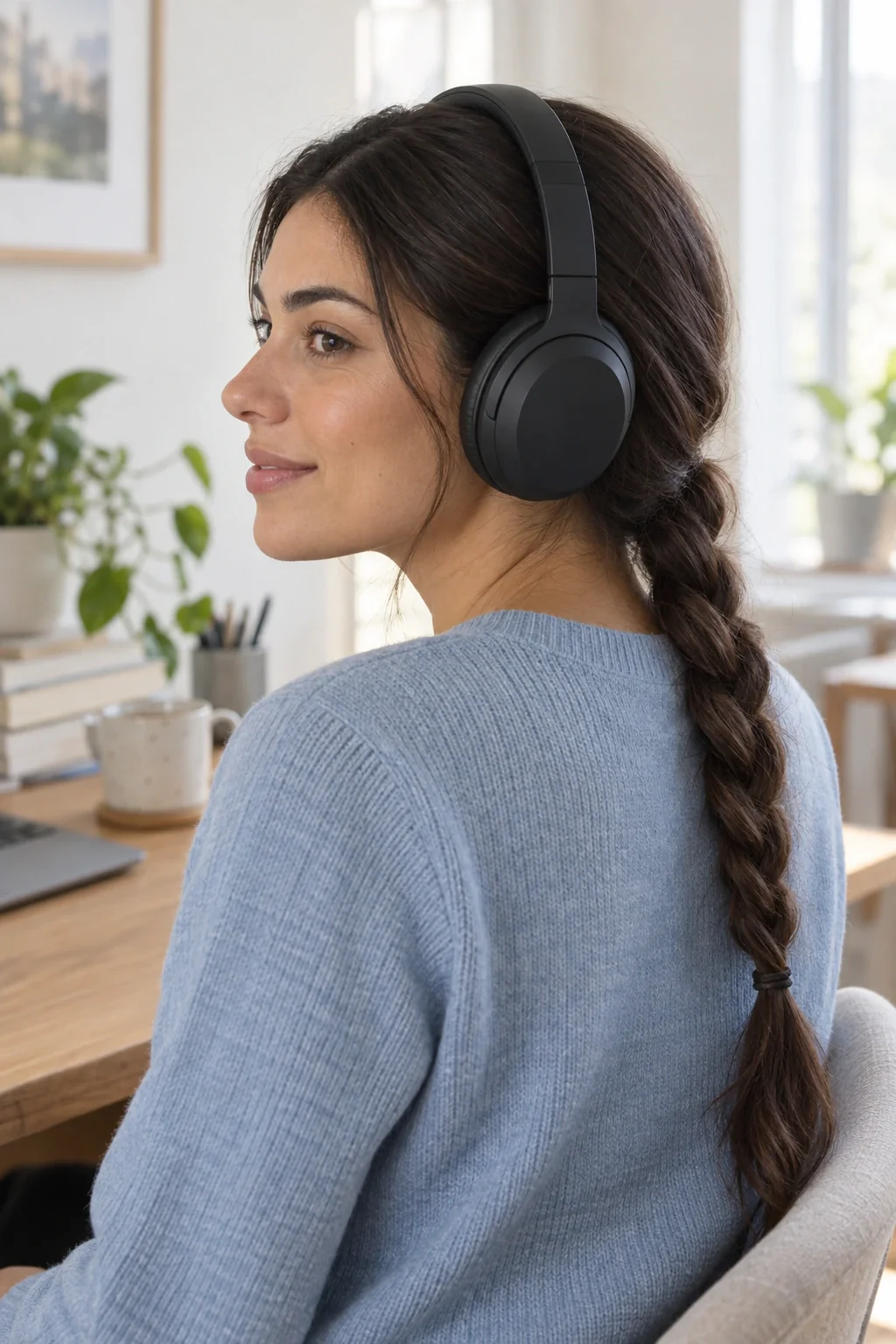
For longer lengths, a loose braid may keep the tail together while leaving the band area clear. For a compact arrangement, try a small gathering placed away from the chair's contact point. Do not assume a high bun will solve every issue: it may sit exactly where the headphones need to pass when you remove them. Lift the pair on and off a few times before committing. An arrangement that works only while the headphones remain permanently in place misses half the problem.
Medium and layered hair may be easier in a partial gathering than in a full ponytail that strains to catch the shortest pieces. Let the front be an independent area. If your layers do not reach comfortably, direct them beside the headset rather than chasing them with stronger tension. The useful distinction is between a section that can join the shape and one that needs its own small solution. A few deliberately loose pieces can make the result easier to maintain.
Treat the fringe as a separate styling zone
A fringe can be pushed forward, split or lifted by a band that sits near it. Put the headphones on before making final adjustments to the front. Check whether their normal position leaves the fringe completely free, touches its roots, or crosses the area you normally sweep backward. Then choose one direction that cooperates with this arrangement. You may prefer a softer sideward movement on headphone days, even if your usual look has more lift at the front.
If you keep a small clip for the fringe, use it only in a position that remains clear of the band and its moving parts. The clip should be easy to find and remove before you lift the headphones off. Avoid building a chain of overlapping pins just to maintain a precise curve during a quiet day at home. It is often simpler to wear the fringe in its practical daytime position and reset its direction when the equipment comes off.
Short hair gives you fewer gathering options but still allows changes in direction. Leave the crown reasonably simple and put the expressive detail in the visible front or one side. A part, a little separation or an exposed ear can carry the mood without adding bulk under the band. Judge the hairstyle both with and without the headphones. If it looks slightly different in each state, that can be a sensible adaptation to the day rather than a styling failure.
Let texture guide the amount of handling
For waves, curls and coils, repeatedly smoothing the band area can change the texture you wanted to keep. Decide which areas you actually need to arrange before each use. If the cups stay in place comfortably with your hair's ordinary volume, there is no reason to flatten the sides merely because the hairstyle in a product photograph is sleek. A focused adjustment around the equipment can coexist with a fuller silhouette elsewhere.
For fine or very straight hair, the concern may be a visible line where the band rested. Treat that as a reset question rather than trying to create an indestructible style. You might choose a soft gathering while you work, then release it and adjust the top before leaving. You might also decide the line is insignificant at ordinary viewing distance. Check in normal light before spending time correcting something that appears dramatic only in a close mirror.
Comfort remains more important than a perfectly controlled surface. The American Academy of Dermatology cautions against styles that pull repeatedly; pain is a reason to loosen or change the arrangement. That general guidance does not diagnose an issue caused by your headphones. It simply supports a sensible styling boundary: do not compensate for slipping equipment or an awkward position by pulling the hair increasingly tight. Reconsider the arrangement itself and follow the equipment maker's fit instructions.
Build a small routine for taking them on and off
The exit movement matters as much as the wearing position. Before taking off the headphones, free any hair that has fallen around their hinges or arms, then lift them without dragging through a fastener. Follow your equipment's normal handling instructions. If you repeatedly uncover one ear, practice that movement with your hairstyle too. A loose section that falls beautifully when both cups are on may catch each time one side is moved.
Keep one useful hair tool where the headphones live. A familiar tie or clip can be enough; the goal is not to establish a second dressing table beside your laptop. Put the item in a small dish or pouch so you can find it without interrupting the work session. At the end of the day, return it there. This minor habit makes a practical style more likely to remain practical than buying several new accessories that do not solve the actual contact problem.
If your day includes calls, check the front view in the same screen framing you normally use. The headphones will already be a visible design element. You may like to keep the hair around them quiet, or enjoy a fuller outline and a bright top. There is no special professional hairstyle required by a headset. Choose the degree of tidiness that feels appropriate for your setting while keeping the arrangement comfortable enough to forget about during the conversation.
Plan the reset for when you leave your desk
Give the released hair a moment to settle before deciding what needs attention. A section that looks compressed immediately after removing the band may sit differently once you separate it gently with your fingers. Look at the whole outline rather than pulling at every individual piece. If the front remains the feature you like, a simple adjustment at the crown may be enough. If the hair has become awkward in several places, regathering it can be faster than recreating a loose style.
Choose your backup in advance: an easy low gathering, a half-up arrangement, or a deliberate side sweep. Pick something you already know how to do without a full mirror setup. The backup should use the length and texture you actually have at the end of the day. A style that depends on pristine morning volume is a poor rescue option after hours under a band. A soft shape can make the day's changed texture feel intentional without pretending it never happened.
For a planned evening, leave a realistic interval between finishing work and leaving. It need not be a complete wash and restyle, but the reset deserves a few unhurried minutes. Put on the evening neckline before making the final gathering. This prevents you from moving a carefully placed shape again because it collides with a collar. The best two-part routine treats the headphone hours and the social hours as related but different settings.
Choose a reset for the mark your headphones leave
After taking the headphones off, let the hair settle before changing it. Look at the affected area: a flat strip at the crown, a displaced fringe or side sections pushed beneath the cups. Adjust that area first. If the rest of the hair still looks good, keep it and use a small front or crown change.
Your reset can differ by texture. A straight or fine-haired look may be easiest to keep gathered if the band has left a visible bend. With waves, curls or coils, separate and redirect only the groups that need attention instead of smoothing the whole head. For an evening after work, put on the next neckline before choosing a new gathering height. Keep the necessary tie or clip beside the headphones so the transition uses an item you already know.
Your questions, considered.
Can I wear a claw clip with over-ear headphones?
Possibly, if the clip sits clear of the band, cups and chair. Try the actual combination while seated, then take the headphones on and off. A smaller or flatter fastener may be easier in your setup, but there is no universally correct size. If you must change your posture to avoid the clip, choose another arrangement.
How do I keep curly hair looking like itself?
Arrange only the sections that interfere with the equipment. Leave the rest of the texture as free as practical and decide on a simple reset for afterward. You do not need to smooth the entire head. Your own comfort and the way the headphones fit should guide the amount of handling.
Should I make my ponytail tighter so it stays put?
Increasing tension is not a good substitute for choosing a workable placement. Try a different gathering height, a suitable fastener or a looser braid. If the style hurts, loosen or change it. A comfortable arrangement that needs one quick reset is more useful than a rigid shape you cannot enjoy wearing.
Sources & what they support
The notes below explain the scope of each source. Hairstyle selections, outfit combinations and comparison exercises are HairSparks’s editorial suggestions; the links do not imply endorsement.
- American Academy of Dermatology: hairstyles and repeated pulling ↗Care guidance on repeated tension from tight hairstyles. Supports the advice to change a style that pulls or feels painful; it does not establish the hold of a particular fastening.
HairSparks and Hair Muse share the same publisher. App mentions are promotional. Read our editorial policy.