
Match the clip to the bundle it must hold. If a full twist overwhelms the jaws, switch to a half-up or leave more length loose. If the clip slides around a small section, try a smaller fastening before twisting tighter.
Claw clip hairstyles for short hair: start with a half-up
Gather the amount of hair you want to lift and hold it where the clip would sit. Notice the thickness of the bundle as well as how far the ends reach. A long but shallow clip can struggle with a dense fold, while a large deep clip may move around a small section. The decorative length of the accessory does not describe its capacity.
Try the proposed fold in your hand first. If it needs several tight turns to fit, choose a smaller gathered section or a different tool. Once the clip is in, release your hands and check whether it supports the shape without a concentrated pull. Use these starting combinations to narrow the choice.
For a bob, start with the upper section
On a bob, a half-up claw clip lets the nape and shorter side layers remain where they naturally fall. Take a small section from above the temples, guide it backwards and give it a gentle turn if that helps contain the ends. Place a compact clip over the connection, checking that it catches enough hair beneath the gathered section to remain stable.
The loose bottom should still have an outline you like. If the sides become sparse, release some hair from the upper section and clip again. For very short front pieces, use two mini clips near the temples instead of making everything reach the middle. This is a different arrangement with the same useful result: an open front and some movement left around the lower edge.
For shoulder-length hair, use a modest fold
Gather the hair low at the back and turn it gently into a short twist. Lift the twist only as far as the length allows, then place the clip around its supported base. The ends may point up, fan out or fall over the top. Try those versions in the mirror before deciding that every end must disappear. A small visible fan can be the feature of the style.
Check the shorter layers beside the ears. If they drop out immediately, pin them separately or leave them loose by choice. Pulling the entire twist tighter often makes those sections feel strained without adding useful reach. ghd's claw-clip tutorial emphasizes anchoring the twist at its base. Use that general idea while adapting the fold and the amount of loose hair to your own haircut.
For long hair, decide where the extra length goes
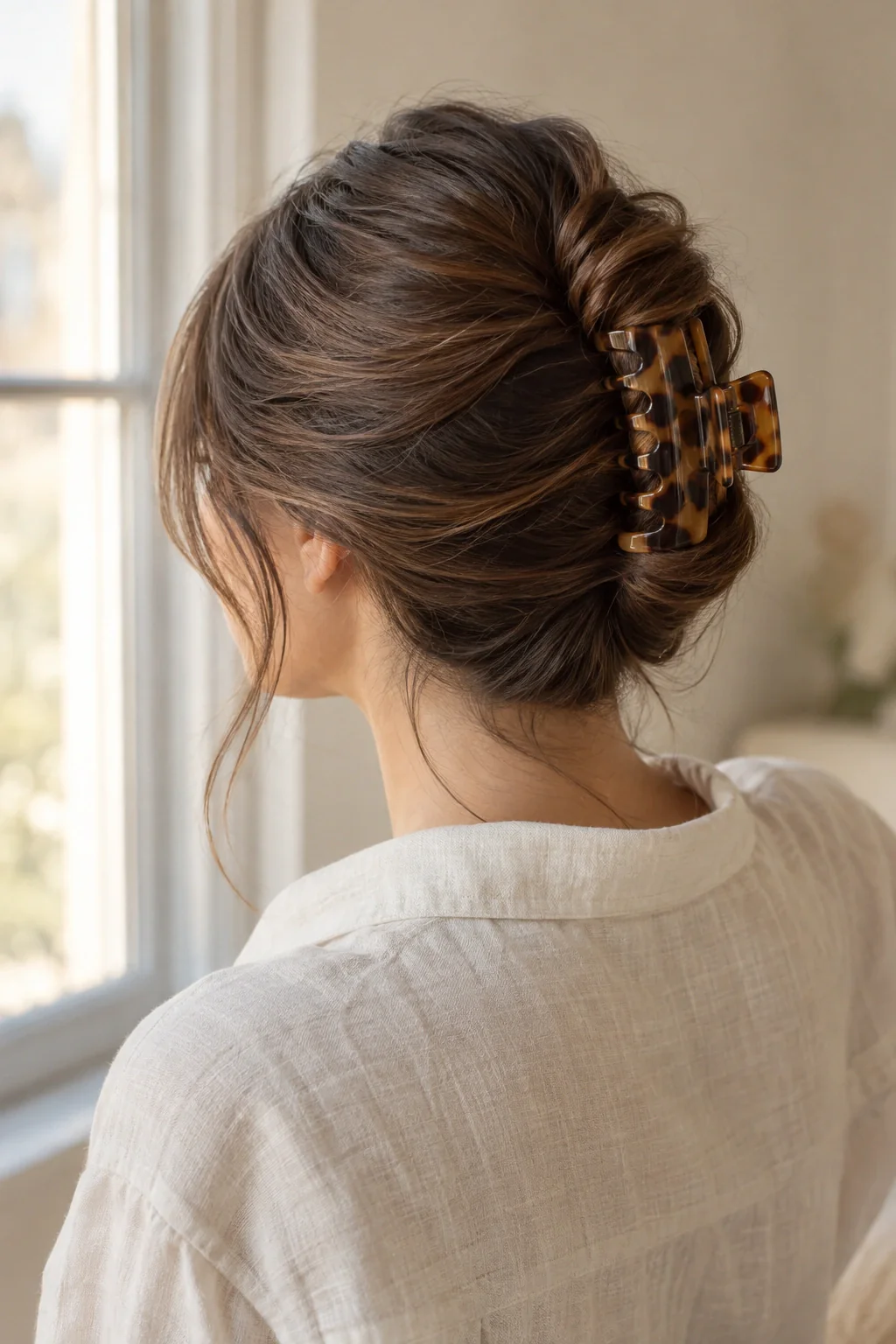
Long hair needs a destination for the ends before the clip closes. Hold a low twist against the head and see how much remains above your intended anchor. You can fold that extra length back down, let it fall over the clip, or make a loose loop. Each creates a different profile, so choose the shape before worrying about a polished surface.
A very thick folded bundle may be too large even for a generous clip. Divide the task instead: choose a half-up style, use a low twist with more length left loose, or switch to a tie that suits the full amount of hair. A claw clip is one tool, not a test of styling ability. It should close without feeling as though its spring is fighting the hairstyle.
Let curls and coils determine the outline
Gather curls in groups with your hands, keeping the shape that you want to see around the top and sides. A high clipped section can let the ends form a soft cloud; a lower anchor can leave a rounded silhouette. You do not need to flatten all the surface texture for the clip to look deliberate. Decide which areas you want gathered and which you want expanded.
Pay attention to how the teeth pass through the section. Open the clip fully before placing it and remove it the same way, supporting the hair with the other hand. If it catches repeatedly, reconsider the clip shape or the amount of hair being held. For dense coils, a partial arrangement may give the right visual effect with fewer compromises than forcing a full-head twist into an unsuitable accessory.
Change the mood through placement and finish
A clip high on the back of the head produces a different line from one sitting low near the nape. Hold the same gathered section in both places and compare the profile. A low arrangement can sit quietly with tailoring; a higher fan can feel lively with an open collar. These are styling suggestions, so use the version that feels most like the outfit you are wearing.
The accessory's finish also matters. Matte brown or black can blend into dark hair, while a pale or translucent piece becomes a visible shape. A metal finish may relate to earrings or a belt, but you do not need every item to match exactly. Choose one intentional connection and keep the rest simple enough that the hair clip feels like part of the outfit.
Read slipping, tilting and pressure as different problems
A clip that slides downward may be gripping a hanging bundle with too little support close to the head. Rebuild the twist in the intended position and check what the jaws contain. If the section is small inside a wide clip, compare a smaller clip. If the teeth cannot settle around the fold, reduce the bundle or choose a roomier shape.
A clip that tilts sideways presents a different problem. Look at how the folded length is distributed beneath it. A large amount falling to one side can rotate the accessory, and a heavy decorative top can exaggerate that movement. Recenter the fold, let the ends fall more evenly, or use the clip for a smaller half-up. Do not automatically wind the whole twist tighter.
Pressure is a reason to take the clip out, even when the hairstyle stays perfectly still. Move the fastening, loosen the twist or switch to a tie or flat barrette. Then test the style with the chair, coat and head position you expect to use. A tall claw clip may be a good daytime accessory yet awkward against a headrest. Keep the alternative nearby so comfort does not depend on preserving the same fastening throughout the day.
Consider the chair, coat and journey
Claw clips project away from the head, so think about the rest of your day. Sit back in the chair you will use, put on your coat and turn your head. A clip that presses against a headrest may be better replaced with a flat barrette or a low tie for that activity. Keep a simple alternative available when you cannot predict the seating or outerwear.
Store the clip where its teeth will not be bent by loose items in a bag, and check for rough or damaged edges before reusing it. At the end of the day, open it fully and support the twist as you release it. Remember the size and placement that worked. That small piece of information is more useful for tomorrow than collecting another photograph of a clip holding a different amount of hair.
Compare the clip and the fold as two separate decisions
If a claw-clip style slips, first recreate the fold with your hands and look at its shape before fastening it. Does the amount of folded hair feel manageable, and do the ends sit where you want them? Then add the clip and assess whether it supports that arrangement. Separating these steps helps you identify whether the issue is the way the length is organized or the relationship between the clip and the section. Changing the accessory alone may not solve a fold that is larger than the shape you want to wear.
Try a smaller gathering or leave part of the length loose, then compare the outline. If that version feels comfortable and deliberate, keep it as a valid style rather than an incomplete attempt at an all-up arrangement. For a longer length, decide where the remaining ends should appear before clipping. For a shorter length, preserve enough loose hair to maintain the outline you like. The exercise centers the finished shape, with the clip serving it rather than dictating a structure that your hair cannot comfortably support.
Make a seated version of your favorite clip style
Wear the arrangement in the chair you use most often, including the way you lean back or turn. If the clip meets the chair, identify whether a different height or a smaller arrangement would help. Compare a version for walking around with one for a desk, car journey or evening seat. They may look similar from the front while placing the hardware differently at the back. This is a practical reason to keep more than one clip placement in your styling vocabulary.
Save a side photograph of the seated version, with a note about where the clip sits relative to your usual gathering point. Practice changing from the first arrangement to the second without rebuilding the front if that is useful for your day. If no comfortable position works with a particular chair, choose another fastening for that setting. The accessory should fit the activity, and a different arrangement can preserve the same relaxed mood without requiring you to sit unnaturally to accommodate the clip.
Your questions, considered.
Do larger claw clips always hold better?
No. Capacity needs to suit the section. A large clip can be too loose for a small amount of hair, while a shallow one can struggle with a dense twist despite its length. Try the clip on the actual bundle and check that it closes comfortably without slipping or forcing the hinge.
Can a claw clip work with layered hair?
Yes, although some layers may need separate handling. Try a half-up arrangement, a lower twist or small side clips for the front. Decide which ends you want visible rather than expecting every layer to disappear into one fastening.
What if my hair feels pulled after clipping it up?
Remove the clip and rebuild the shape more loosely, change the anchor location or gather less hair. Pressure is a reason to adjust the style. If one clip keeps creating the same problem, choose an alternative fastening rather than repeatedly tightening the twist.
Sources & what they support
The notes below explain the scope of each source. Hairstyle selections, outfit combinations and comparison exercises are HairSparks’s editorial suggestions; the links do not imply endorsement.
- ghd: Claw clip hairstyles for long hair ↗Technique example for a twist secured with a claw clip, including comfortable gathering. The troubleshooting choices here depend on the reader’s hair and accessory.
HairSparks and Hair Muse share the same publisher. App mentions are promotional. Read our editorial policy.