
Leave room around the shoulder detail you want to show. Move the hair to one side for a bow, lift the front above puff sleeves, or place a twist clear of a raised ruffle. Keep natural volume where it does not catch.
Match the hair placement to the shoulder detail
The shape of a statement shoulder gives you a useful landmark for placing the hair. A bow occupies one spot; a puff sleeve rises and widens as your arm moves; a ruffle may continue around the back of the neck. Find that landmark while wearing the garment. Then choose a hairstyle that leaves room beside it, or deliberately lets a little hair overlap its edge.
A completely exposed shoulder gives the garment a clearer outline. A partial overlap can soften it, especially when you enjoy loose curls or longer layers. Both need a movement check: lift an arm, reach across your body and turn your head. If the same section repeatedly catches, secure that section separately. Short hair may already clear the garment, in which case the useful adjustment is at the temple, fringe or earring.
Map the space when your arms are moving
Statement sleeves do not remain in the same position throughout the day. Lift an arm to reach for a bag, sit at a table and turn as though speaking to someone beside you. Watch whether the shoulder detail rises toward the hair, pushes a loose section forward or brushes an accessory. The useful hair arrangement is one that makes room for those movements, not simply one that looks balanced with both arms held still.
If the fabric keeps catching a low fastening, try moving the fastening slightly higher or farther toward the center of the head. If a loose section repeatedly sits beneath a fold, bring it fully forward or fully back instead of leaving it balanced on the edge. The adjustment can be small. You do not need to pull the whole hairstyle more tightly to solve a collision between one fabric detail and one hair section.
Compare generous hair with a generous shoulder
A full hair silhouette and a full sleeve can create an expressive combination. Try it before deciding there is too much volume. The key question is whether you can still read the shape you enjoy in each. A rounded curly outline above a sculptural shoulder may feel coherent, while long loose hair spread across both shoulders may conceal the garment. That does not make one texture more suitable; it makes placement the more useful variable to examine.
For a clearer relationship, bring some of the hair behind the shoulder while keeping the natural width above it. Alternatively, gather the upper section and allow the lower lengths to fall behind the back. Short hair can stay full while one temple becomes more open. These variations preserve the hair's character. Choose a smaller outline only if you like that contrast, rather than assuming that the garment has used up an imaginary allowance of volume.
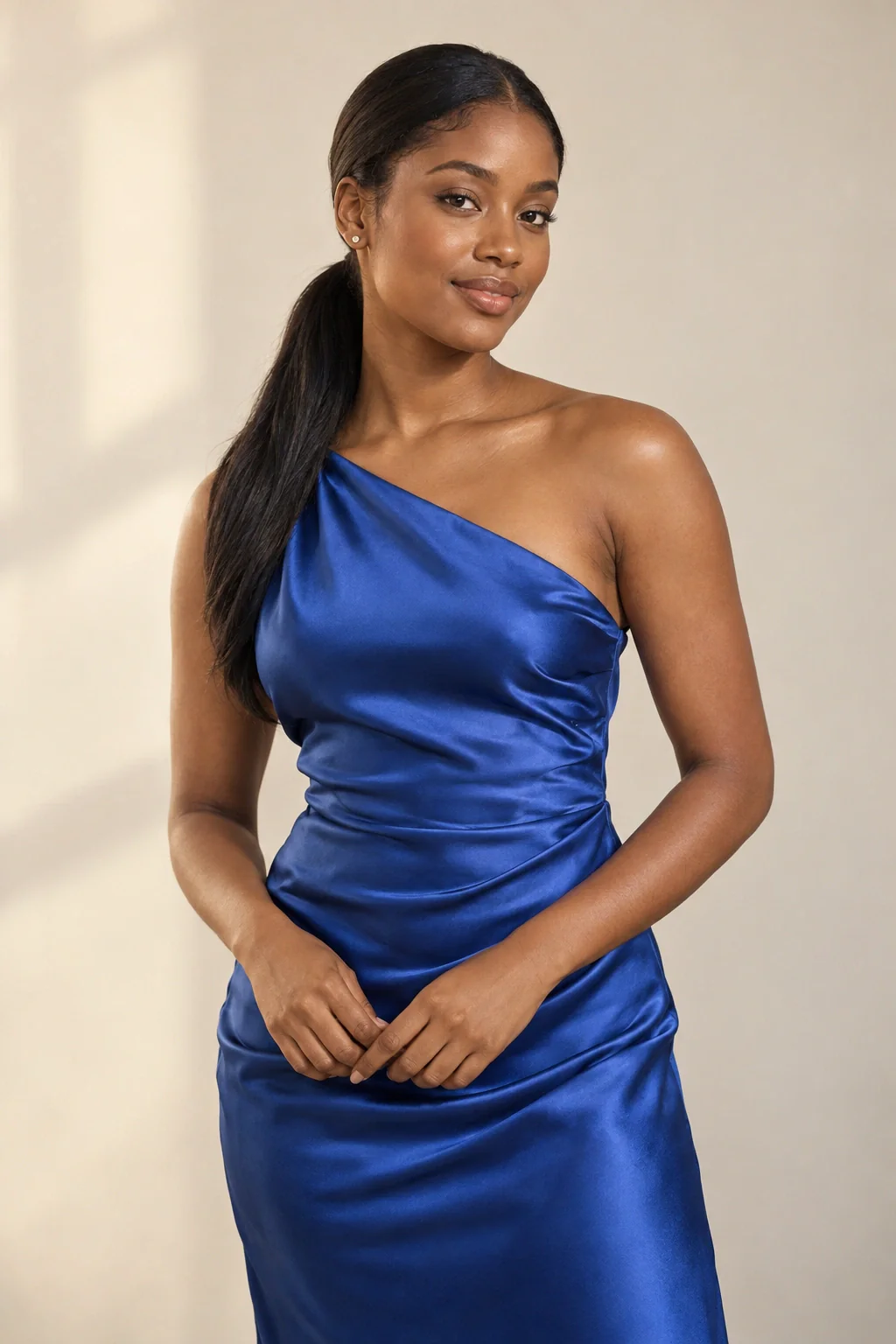
Give a one-shoulder detail two honest options
With one prominent shoulder, first place the hair toward the opposite side. This exposes the garment and creates an obvious asymmetry. Then try the reverse: some hair on the decorated side, with the other side open. The second option may feel more integrated or less predictable, particularly if the shoulder detail is small. Evaluate both in a front photograph and a slight three-quarter view; the preferred arrangement can change when the full depth of the garment is visible.
Keep comfort separate from the visual comparison. If moving all the hair to one side makes you keep turning your head to hold it there, use a discreet anchor or choose a less extreme placement. The hair does not need to stay motionless to support the idea. A side direction with some natural movement can be enough. Write down whether you prefer the detail fully exposed, partly overlapped or echoed by an accessory on the other side.
Put fastening points where the garment leaves room
A low bun may sit directly above a ruffled back collar. A side clip can meet a high puff sleeve when you turn. Before deciding that an accessory is wrong, check whether it simply occupies the wrong position for this garment. Gather the hair with your hand and move the proposed anchor a small distance in several directions. This lets you test the available space without repeatedly fastening and unfastening the whole style.
Choose an accessory that fits the amount of hair it needs to hold. Decorative size and fastening capacity are not the same thing. A large ornament may hold only a small section, while a quiet clip can have a substantial grip. If a fastening cannot close comfortably, choose another one rather than forcing it. The Academy of Dermatology recommends avoiding hairstyles that repeatedly pull tightly; a sculptural outfit is not a reason to tolerate a fastening that feels strained.
Adapt the open-space idea to short hair
A pixie, cropped shape or short bob can show statement shoulders without needing an updo. Try changing the front direction, exposing one temple or placing a small accessory above rather than beside the ear. The difference may be subtle close up, but visible when the garment is included. If the hair already sits above the shoulder detail, leave the back alone and focus on the relationship between fringe, earrings and the highest part of the sleeve.
For a bob that rests on the shoulder, compare the ends sitting forward, tucked behind one ear and guided behind both shoulders where possible. Do not force shorter pieces to reach a distant fastening point. A partly open side can be enough to reveal a fold or bow. Let the haircut keep its recognizable outline, and use the garment as a reason to experiment with direction rather than as a demand for a hairstyle your length cannot comfortably make.
Edit the nearby accessories one at a time
Shoulder details often sit near earrings, necklaces and hair ornaments. Put on the piece of jewelry you care about most, then add the others gradually. A long earring may occupy the same space as a ruffle; a hair bow may visually repeat a shoulder bow; a necklace may disappear between hair and a raised neckline. Repetition can be intentional, but first decide whether you want a repeated motif or one clear focal point.
Photograph the combination before and after removing just one accessory. If you prefer the fuller version, keep it with confidence. If the shoulder detail becomes clearer without a necklace, you have found a practical edit rather than a universal rule. Check movement as well as appearance: an earring that repeatedly catches a curl or brushes a stiff fold may be better replaced, even if its shape looks good. The final arrangement should let you turn and talk without managing several moving objects.
Try three garment-specific starting points
For a blouse with two rounded puff sleeves, compare a low gathered shape with a full loose shape held away from the front. The first gives the shoulders a clear frame; the second creates a more generous overall silhouette. With a dress featuring one large shoulder bow, begin with the bow visible and the hair mostly behind the opposite shoulder. Then test a softer overlap if complete separation feels overly staged to you.
For a top with a sculptural ruffle running from shoulder to neckline, identify where the ruffle is highest. Leave a little room at that point and place the hair where the fabric is lower. You might use a half-up arrangement, an open side or a compact gathering. These examples are starting experiments, not prescribed matches. Keep the version that suits the garment you actually own, including how its fabric bends, settles and moves during ordinary wear.
Plan the coat and the arrival adjustment
A statement shoulder may already need care when putting on outerwear, so keep the hairstyle change simple. Test the coat before an event and notice whether the collar or lining shifts the hair. If a decorative clip makes dressing awkward, carry it separately and add it after removing the coat. You can travel with a functional fastening and change only the visible finishing piece once you arrive.
Avoid a plan that requires rebuilding hidden pins in a small restroom mirror. Instead, choose one arrival action: move the lengths behind a shoulder, release a temporary gathering or add one accessible clip. Store the accessory where you can find it without emptying a bag. If someone is helping you dress, show them the hair arrangement beforehand so they can avoid placing a strap or collar over it. A brief practical rehearsal is more useful than adding extra hold everywhere.
Adapt the look when the sleeve keeps touching the hair
A sleeve can look clear while you stand still and meet the hair every time you lift a glass. Before adding more pins, repeat the movement that causes contact. Watch whether the fabric reaches the loose ends, a decorative clip or the fastening itself. Moving a clip upward will not help when the loose tail below it is the part resting inside a ruffle.
Keep the feature you originally wanted. If that was a full curl outline, redirect the lowest curls behind the shoulder while leaving the upper shape alone. If it was an exposed back, move the entire gathering a little higher and retest the collar. For a crop or bob, one small side clip may do more than trying to gather the back. Keep the fastener clear of the sleeve.
Your questions, considered.
Do puff sleeves always look better with hair up?
No. Hair up is one way to expose the shoulder shape, but loose hair can create an appealing generous outline or soften a structured sleeve. Compare both while wearing the actual garment. Pay attention to where the hair rests and how the sleeves move. A small front anchor may give you the visibility you want while leaving most of the hair loose.
Which side should I put my hair on with one statement shoulder?
Start by exposing the detail, then test a partial overlap or the opposite direction. The preferred side depends on the garment, your part and the look you enjoy. Use front and three-quarter photographs, because a side that appears crowded straight on may look balanced from another angle. Choose a placement that does not require constant head positioning to stay in place.
What if my short layers cannot reach an updo?
Work with the lengths that comfortably reach and let the rest form a deliberate edge. An open temple, a shifted fringe or one small clip can change the relationship with a shoulder detail. There is no need to conceal every short piece. If the garment already has clear space below your hair, your usual short style may need very little adjustment.
How can I tell whether I have added too many details?
Ask where your attention goes first and whether that is the feature you wanted to emphasize. Remove one accessory, photograph again and compare. You may prefer the more expressive version; the purpose is to make a conscious choice. Also check whether earrings, clips and fabric catch one another. Physical interference is a more concrete reason to edit than a vague rule about the number of accessories.
Sources & what they support
The notes below explain the scope of each source. Hairstyle selections, outfit combinations and comparison exercises are HairSparks’s editorial suggestions; the links do not imply endorsement.
- American Academy of Dermatology: avoid hairstyles that pull tightly ↗Care guidance on repeated tension from tight hairstyles. Supports the advice to change a style that pulls or feels painful; it does not establish the hold of a particular fastening.
HairSparks and Hair Muse share the same publisher. App mentions are promotional. Read our editorial policy.