
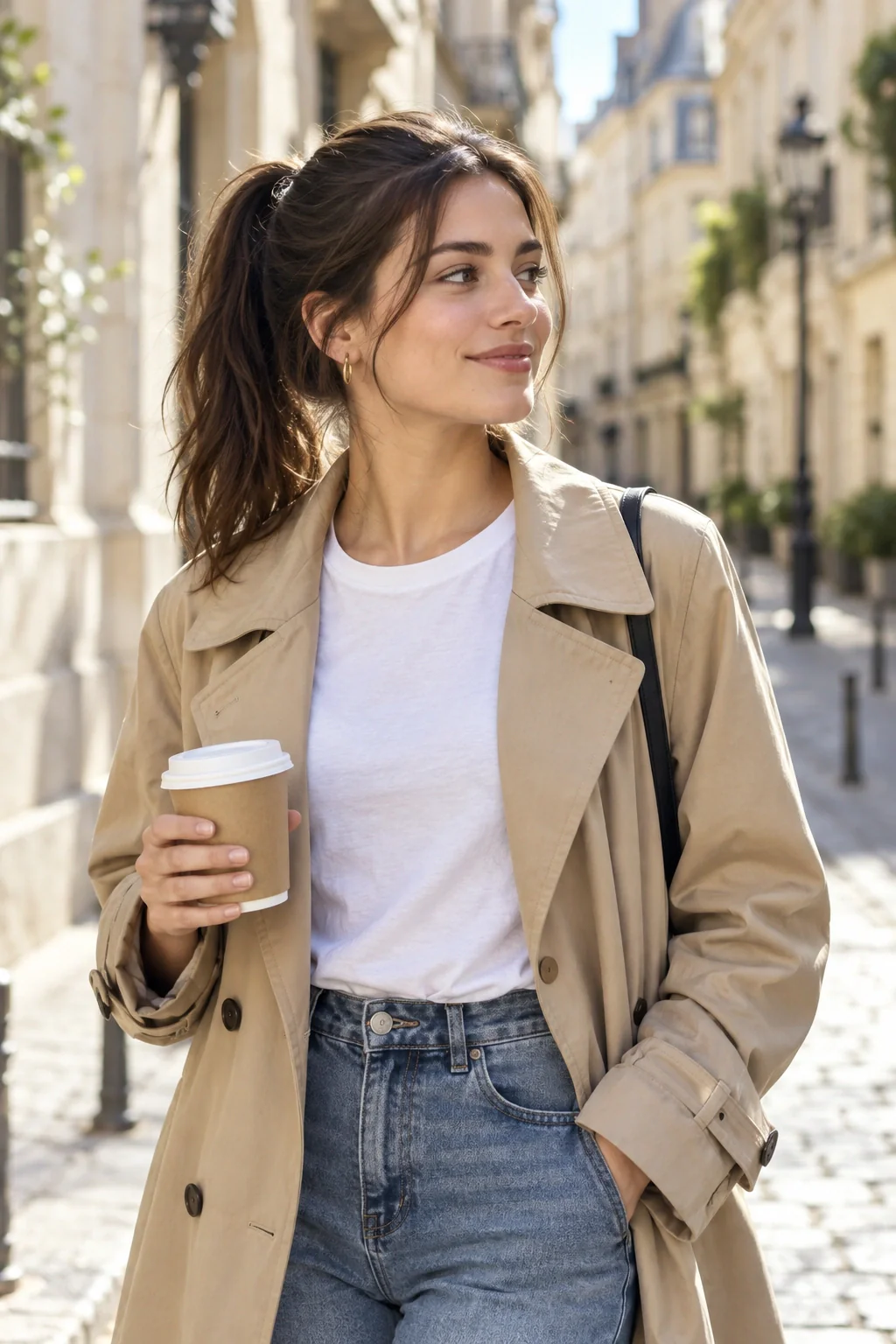
Keep the main lengths clear while putting the backpack on and taking it off. Test a forward braid, well-placed ponytail or small half-up section with the loaded bag and coat. Leave bulky fasteners outside contact areas, then reset the front after arrival.
Choose a style that clears the loaded backpack
Put your usual belongings in the backpack and wear the coat you expect to use. Adjust the bag according to its maker’s guidance and your normal fit. Now check the top edge, shoulder straps and handles near the nape. Choose a hairstyle that can sit around those points without changing how you should carry the bag.
The contact matters more than the hairstyle’s name. A low ponytail can work with a short bag and sit awkwardly against a taller one. A braid can keep long lengths together but still needs moving clear of a strap. For a bob or crop, the collar may be the main issue. Curls, coils, braids and locs can keep their existing texture; distribute the length or move the fastening where the bag leaves room.
Decide where the lengths will travel
If you enjoy loose hair, choose whether it will sit over one shoulder, in front of both straps or behind the shoulders with clear space above the bag. Test the arrangement in movement. Hair that stays neatly forward while you stand still may move backward as soon as you walk. You do not need to control every strand, but you should know whether the main length repeatedly ends up underneath the straps and requires attention.
A loose braid can keep longer lengths together while allowing you to place them to one side, if that suits your routine. A ponytail may be easier to reset but can still swing into a strap depending on its height and length. A gathered arrangement can reduce loose length, though its fastener must sit comfortably with the collar and bag. These are practical options to compare. No single style is automatically best for every backpack or every hair length.
For medium hair, a partial gathering may keep the front manageable while the shorter lengths remain above the bag. For a bob or crop, the main concern may be the nape meeting a raised collar rather than the straps themselves. Work with the actual contact area. Do not add an elaborate updo to solve a problem that could be handled by changing the front direction or moving one small section before you put the bag on.
Place fasteners around the bag and outerwear
Gather your hair at a few comfortable heights while wearing the coat and backpack. Check which position leaves enough room for the fastener and allows you to turn normally. A low knot may work with one collar and feel crowded with another. A higher arrangement may avoid the bag but conflict with a hood or the way you sit during the journey. The answer comes from the full combination, not from labeling one height as universally practical.
Consider the shape of the fastener as well as its position. A bulky clip can project farther than the hair itself, while a small tie creates a different contact point. Choose an item you can remove gently and put back without a complicated mirror setup. The American Academy of Dermatology's general hair-care guidance includes using suitable covered bands and handling hair carefully. For this commute, the editorial application is to avoid treating a trapped or uncomfortable fastener as something to pull past in a hurry.
Keep decorative pieces separate if they make the journey awkward. You can add a larger bow or comb after arriving, provided that is a simple step you enjoy. This does not make the commute hairstyle incomplete. It gives the accessory a place in the sequence where it can be worn comfortably. If you prefer the whole look ready before leaving home, choose a decoration whose size and placement work with the bag rather than expecting the bag to stop behaving like a bag.
Use a repeatable bag-on, bag-off sequence
Before putting on the backpack, gather the loose length out of the straps' path with your hand or arrange it in the position you chose. Put the bag on normally, then release the hair where you want it. This brief sequence is often easier than freeing trapped strands after both straps are already in place. Practice slowly so it becomes familiar. If the hair catches, stop and release it carefully rather than continuing the movement and hoping it slips free.
When removing the bag, pay attention to the same areas. A braid over the shoulder may sit across a strap; a loose front section may have moved beneath it. Clear the hair, then take the bag off. The exact movement depends on your bag and mobility, so choose the comfortable method that works for you. The point is to notice the transition, not to prescribe a particular choreography that everyone must follow.
If you take the backpack on and off frequently during the day, prioritize a hairstyle that makes this easy. A look that is manageable for one morning journey may become irritating when repeated between classes or appointments. You might use a more contained shape on those days and leave the loose version for a simpler commute. The hairstyle can respond to the number of transitions as well as the length of the journey.
Plan around the collar, hood and weather layers
Outerwear often creates more contact than the backpack itself. A rolled scarf, raised collar or hood can occupy the space where you usually place a low gathering. Try the full cold- or wet-weather combination before deciding that the hairstyle is ready. If the hood needs to go up, check it in the way you normally wear it. Follow any clothing or equipment guidance relevant to your journey, and choose the hair arrangement around those practical needs.
A style that looks good with an open jacket may behave differently once the front is closed. Loose lengths can sit against the collar, and a tucked side may reappear when you turn. Decide which changes you are willing to accept during travel. You may prefer a simple contained arrangement until you are indoors, then release the front. You may be comfortable with movement and choose only to keep the main length clear of the straps. Both are reasonable if they feel manageable.
Do not make stronger hold the automatic answer to every weather-related change. Sometimes a different gathering position or an arrival reset is more realistic. If you know your hairstyle will be compressed by the hood, choose a version that can be redirected afterward. The commuting look does not have to preserve a fragile shape through every layer. It needs a sensible path from leaving home to taking the outerwear off again.
Keep the arrival reset small and specific
When you arrive, put the backpack down and remove the outer layer before making final hair adjustments. Otherwise you may restore a shape only to disturb it while taking off the coat. Let the hair settle, then check the area most affected by the journey. That might be the nape, one side or the front. Start with the actual problem rather than assuming the entire hairstyle needs rebuilding because it has been traveling.
Choose a default reset you can do with one familiar item. You might move a ponytail slightly, release the front from a practical tuck or change a compact gathering into a half-up shape. Keep the item in a small accessible pocket or pouch so the routine does not involve unloading the whole bag. A mirror can help, but the method should be familiar enough that you are not learning it from a video just before the workday begins.
For an important meeting or presentation, leave a little more arrival time and decide on the finished hairstyle in advance. The commute can use a simpler version of the same idea, with the final detail added indoors. If a full restyle is necessary to achieve the look you want, acknowledge that when planning the morning. A realistic preparation window is more useful than a complicated travel arrangement designed to protect a finish that is easily disturbed.
Adjust the routine when the bag or destination changes
A day with a small backpack and casual clothes is not the same as a day carrying work equipment under a heavy coat. Recheck the contact points whenever you change the bag or outer layer significantly. You may find that the hairstyle still works with a small adjustment. You may also decide that a different familiar arrangement is more sensible. There is no need to discard your everyday style simply because one specific combination creates an awkward collision.
The destination matters too. A library day may allow a relaxed reset whenever you settle into a seat. A public-facing shift may call for a more defined arrival routine or specific hair requirements. Follow those requirements first, then choose the commuting version that transitions into them easily. This prevents the morning from becoming two unrelated styling projects. The hair you wear on the journey can be designed as the first stage of the arrangement you need when you arrive.
If your journey includes activities requiring protective equipment, fit and safety requirements take priority. Do not modify a helmet or another required item to accommodate a hairstyle, and follow its manufacturer's instructions. This guide addresses backpack contact, not equipment certification or fit. You can still use the same planning principle: identify the non-negotiable equipment needs, choose a comfortable compatible hairstyle, then reserve the expressive finishing details for the point where they no longer interfere.
Solve the catch at the moment it happens
If hair repeatedly catches, slow down the bag-on or bag-off movement and locate the exact point. A strap trapping loose length needs that length moved beforehand. A handle touching a bun needs another gathering position. A projecting clip caught by the collar may need a flatter alternative.
Practice the sequence with the loaded bag and outerwear you use most. The comfortable movement will depend on the bag and your mobility, so avoid a routine that requires an awkward reach. When you arrive, remove the outer layers before restoring the front or adding a decorative accessory. A simple commuting version can lead into your preferred indoor hair with one small change, instead of trying to preserve a fragile finish through every strap and collar.
Your questions, considered.
Is a low bun best with a backpack?
It depends on the bag’s top edge, your collar and the bun’s position. Try several comfortable heights with the bag loaded normally. A low arrangement can work well, but it may also sit directly in a crowded area. Choose the position that lets you move and remove the backpack without pressure or catching.
Can I keep long hair loose during the commute?
Yes, if you can place the lengths comfortably and keep them clear while putting the bag on and off. Test whether they stay in front of the straps or move underneath as you walk. If repeated catching becomes annoying, a loose braid or temporary gathering may make the journey easier, with the hair released after arrival.
What should I carry for a quick arrival reset?
Carry the familiar fastener or small tool required for one chosen reset, plus a spare if you rely on it. Keep it in an accessible pouch. The best kit is specific: it helps you move a gathering, restore the front or add an accessory after the coat comes off. A full styling collection is rarely necessary for that limited job.
Sources & what they support
The notes below explain the scope of each source. Hairstyle selections, outfit combinations and comparison exercises are HairSparks’s editorial suggestions; the links do not imply endorsement.
- American Academy of Dermatology: hair bands and gentle handling ↗Care background on gentle handling and avoiding repeated pulling. Used for comfort and fastening guidance, without diagnosing an individual hair or scalp concern.
HairSparks and Hair Muse share the same publisher. App mentions are promotional. Read our editorial policy.