
Build the hairstyle with a fastener that holds comfortably, then add decoration. If a clip slides, change its size, position, or section before adding product. For fine hair, start lighter; for dense sections, check that the clasp closes without force.
Choose the fastening by the job
Lay the accessory beside the section you intend it to hold. A narrow barrette that works at the temple may be too small for a half-up style, while a large claw can feel unnecessarily bulky on a small twist. Overall hair length is only a rough guide: the amount of hair inside the mechanism matters more.
Decorative and structural pieces can be separate. A ribbon can sit over a ponytail tie, a bow can cover a plain barrette, and a comb can decorate a style already supported by pins. This lets you choose the visible detail without asking its ornament to carry more hair than it can manage.
Match the grip to the amount of hair
Pick up the actual section you want to secure. Its thickness and shape may differ considerably from the loose hair you see in a photograph. Test whether the clip closes normally around it without forcing the mechanism. If it barely closes, reduce the section or choose a piece designed to accommodate more hair. If it slides through the section, adding more hair may help, but only if that still creates the hairstyle you want.
The right size is not determined by overall hair length alone. A short, dense section can need more capacity than a longer, finer one. Try the accessory in several positions, including the angle at which you intend to wear it. Avoid repeatedly squeezing a piece that is clearly mismatched. A smaller section with a decorative finish can be more attractive and more comfortable than a large arrangement held by an accessory operating at its limit.
Choose visible placement with the whole outfit
A clip above the ear, a bow at the back and a scarf at the nape create different focal points. Put on the outfit and decide where you want the eye to land. If the neckline has a large bow already, another bow beside it may feel deliberate or may compete. A simple top can leave room for a larger hair detail. Neither outcome is wrong; the point is to see the combination before committing.
Check profile and back views as well as the front. An accessory that disappears in a selfie may be beautifully placed for an event where people see you from several angles. If you want it visible in a headshot, move it into the camera’s likely view rather than making it unnecessarily large. Consider your hair color too. High contrast makes the piece more prominent, while a similar color can reveal its shape mainly through texture and light.
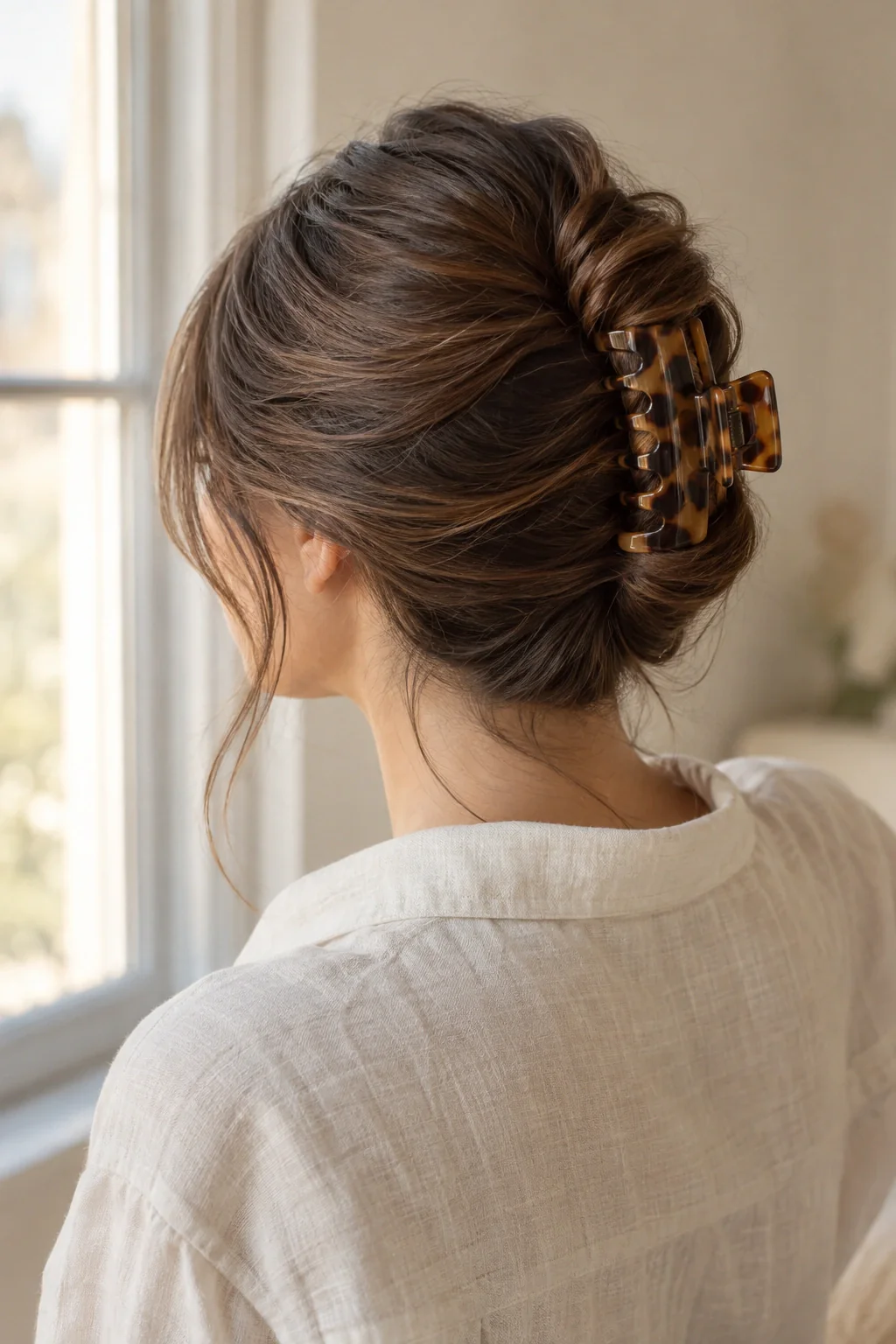
Keep the arrangement comfortable in motion
Wear the trial style long enough to notice pressure points. Turn your head, look down and rest against a chair. A claw clip can feel fine while standing and awkward against a headrest. A headband may become uncomfortable behind the ears. Do not treat discomfort as proof that the piece is holding properly. The American Academy of Dermatology advises against accepting painful pulling from hairstyles; comfort belongs in the selection process from the start.
Change placement or reduce the amount of hair held before adding more force. If the accessory still creates pressure, choose another piece for that occasion. For travel, you may prefer a flatter fastening that can remain in place while seated. For dancing, choose a piece whose edges and decorative parts stay close enough that you are not constantly checking them. A useful accessory should let you participate in the day rather than monitor it continuously.
Work with texture instead of hiding it
Curls, coils, waves and straight hair can all support accessories, but they may hold and reveal them differently. A small clip may disappear into dense texture; a larger piece may become the intended focal point. With finer hair, a heavy accessory may pull the section downward. Rather than forcing a reference arrangement, test a smaller section, a different angle or a lighter object that gives a similar visual effect.
Do not separate every curl simply to create a perfectly flat surface for a clip. You can position the piece over a gathered group while preserving the surrounding pattern. With straight hair, an intentional visible fastening can make a simple tuck feel complete. If the accessory repeatedly slips, reconsider its construction and placement before layering on products. The goal is not to make your hair behave like the model’s; it is to find a reliable relationship with the object.
Practice removal as carefully as placement
A successful accessory needs an exit plan. Learn how its clasp opens before inserting it, and note whether decorative chains, teeth or fabric edges can catch. Remove the piece slowly while supporting the hair nearby. If you have used several pins beneath a bow or scarf, remember where they sit rather than pulling the whole arrangement apart at once. Keeping the structure understandable makes both adjustment and removal easier.
For an event, store a spare fastener in a small pouch where you can find it. Choose one that can perform the essential job if the decorative piece breaks or becomes uncomfortable. That may be a plain tie rather than an identical ornament. If the accessory is sentimental or difficult to replace, consider whether the event involves vigorous movement or frequent clothing changes. Wearing it for photographs and switching later can be a sensible way to enjoy it.
Troubleshoot a clip before buying another collection
When a clip slides down, first notice what slides: the whole section, only the top layer, or the clasp itself. If a heavy ornament drags a fine section downward, try a lighter piece with a similar color or shape. If the clasp barely catches any hair, increase the section slightly while keeping the intended style recognizable. More product is not the first adjustment to make.
When a claw will not close, do not squeeze it around the same oversized twist. Fold less length into it, divide the hair into a smaller half-up section, or use a clip with suitable capacity. The correct solution should close without a struggle. If the teeth press into your head when you sit, changing capacity alone will not help; choose a flatter shape or another position.
When a barrette disappears in curls, decide whether visibility matters. If it is only holding the front, hidden placement may be ideal. If it is the decorative feature, move it toward the temple or choose a broader visible surface without taking more hair into its clasp. Finish each test with removal. A piece that looks right but catches repeatedly during unclasping is a poor everyday match, even if its grip seems dependable.
Audit an accessory that looks good but never gets worn
Take one clip, bow or headband you repeatedly choose in the mirror and remove before leaving. Describe the reason precisely. Perhaps the decoration feels too large beside your everyday earrings, the fastening sits where your glasses rest, or it holds only when placed at an angle you dislike. Separating appearance from function gives you a useful next move. You may need a different hairstyle, a quieter outfit pairing or an accessory with a more suitable mechanism, rather than more determination to wear it.
Try it once with a simple outfit and a deliberately modest amount of hair. If the functional problem persists, stop building the style around it. If the function works but the ornament feels unfamiliar, take a photograph from conversation distance and compare it with your original close-up. A detail can feel enormous when you are examining it inches from the mirror. The decision is still yours; the exercise simply lets you judge the scale under the conditions in which you will wear it.
Give each accessory a place in a small styling map
Lay out the accessories you already own and group them by actual use: holding a front section, gathering the back, adding a visible accent or supporting a temporary change. An item can have more than one role, but write down the arrangement in which it has already worked. This keeps the map grounded in experience. A beautiful barrette that has never held your hair reliably belongs in the experiment group, rather than being counted as the only fastening for an important event.
Select one reliable option for each role you need during an ordinary week. Test the decorative pieces with those dependable arrangements before adding more complexity. Store a quick side or back photograph beside the accessory's description so you remember its placement. When considering another purchase, identify the missing job first. You may discover that you need a smaller everyday fastening rather than another statement piece, or that your existing collection already covers the styles you genuinely enjoy wearing.
Your questions, considered.
Can a decorative bow hold a ponytail by itself?
Sometimes, depending on how it is constructed and how much hair it needs to hold. Test it rather than assuming. If the bow slides or its fastening feels strained, secure the hair with a suitable tie first and use the bow as decoration. The visible result can stay the same while the structure improves.
How do I choose a clip for fine hair?
Start with a small section and a piece that is light enough not to drag it downward. Test the clip in the position you intend to wear it, since angle affects how it sits. If it repeatedly slips, choose a different mechanism or section size instead of forcing a larger, heavier accessory.
Is it okay to mix different accessory materials?
Yes. Metal, fabric and colored resin can sit together if you enjoy the result. Choose which piece should lead and give it enough space. Check the full outfit and practical contact points, particularly earrings, glasses and collars. Visual coordination is a preference; comfortable placement and suitable fastening are the essentials.
Sources & what they support
The notes below explain the scope of each source. Hairstyle selections, outfit combinations and comparison exercises are HairSparks’s editorial suggestions; the links do not imply endorsement.
- Wella Professionals: styling with hair accessories ↗Examples of styling with accessories. Used for the distinction between a decorative finishing piece and the fastening that supports a style.
- American Academy of Dermatology: hairstyles that pull ↗Care guidance on repeated tension from tight hairstyles. Supports the advice to change a style that pulls or feels painful; it does not establish the hold of a particular fastening.
HairSparks and Hair Muse share the same publisher. App mentions are promotional. Read our editorial policy.